// blog
Where to Launch Your SaaS in 2026: 25 Platforms Indie Developers Actually Use
A single SaaS launch day in 2026 returns about 700–1,500 visits and under 50 signups. Here are the 25 platforms indie developers actually use — with real prices, traffic numbers, and the order to launch in.
- saas
- indie hacking
- product launch
- startup marketing
- product hunt
- seo
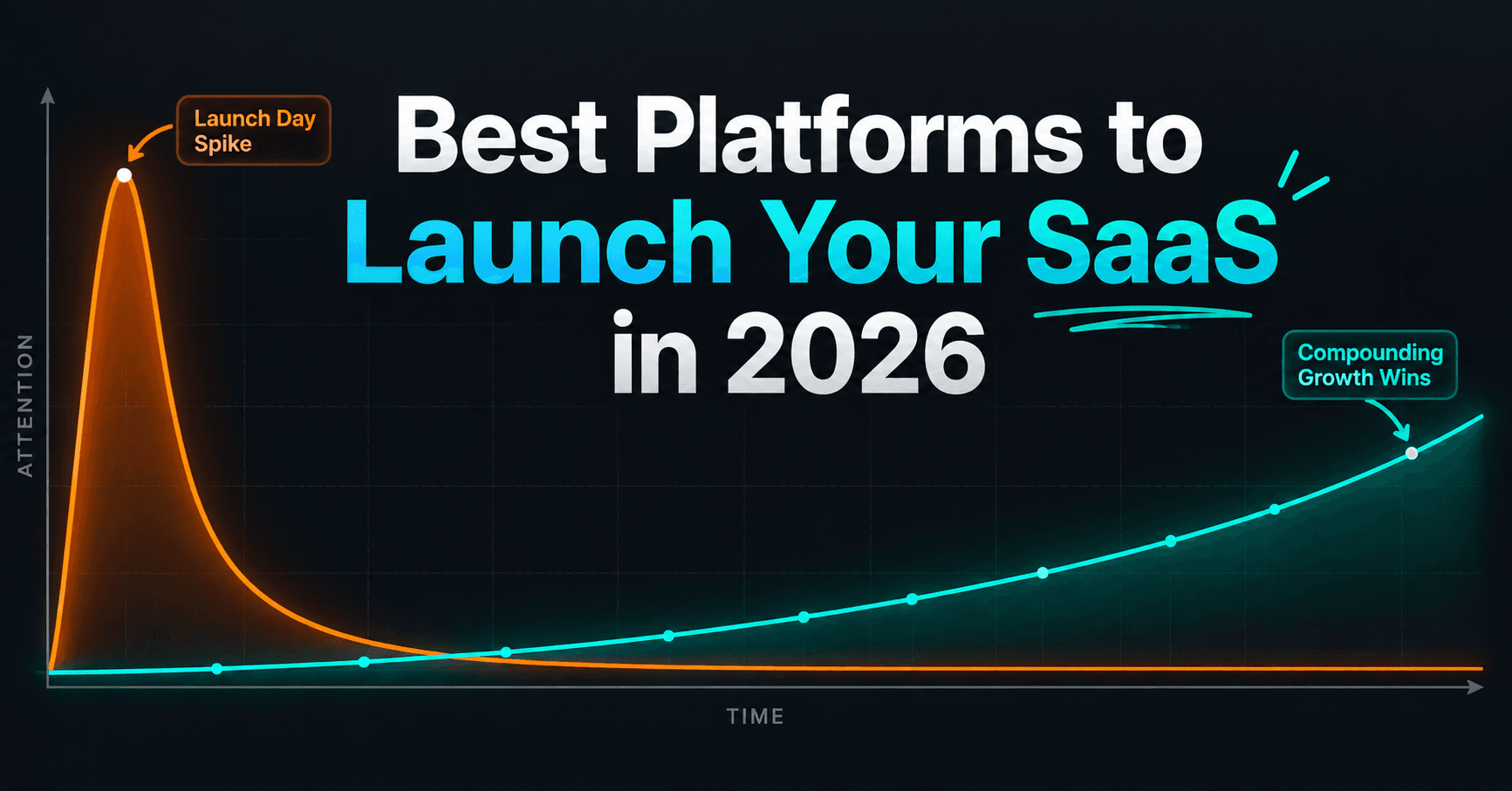
Launch your SaaS on one high-traffic platform for the spike and 8–10 evergreen directories for the compounding traffic — Product Hunt or Show HN on day one, then Uneed, Fazier, Peerlist and SaaSHub across the following two weeks. A single launch day in 2026 typically returns 700–1,500 visits and under 50 signups, so the listings that keep ranking six months later are worth more than the day itself.
I ship products as a solo developer, and the thing nobody tells you is that the launch is the cheap part. Choosing where to spend your one launch is the expensive decision. This is the list I actually work from, with prices and numbers current as of September 2026.
Where should an indie developer launch a SaaS product in 2026?#
Launch on 3–5 platforms, not one. The 2026 pattern is one spike platform (Product Hunt or Hacker News), two or three newer launch boards (Uneed, Fazier, Peerlist Launchpad), and 30–50 directory submissions for backlinks. Founders who bet everything on a single launch day get one day of traffic.
The reason the strategy changed is mechanical. Product Hunt now sees 500+ products go live on a typical day (as of September 2026), and its outbound links are nofollow, so they pass no search authority. You get 24 hours of attention and nothing that accrues. Directories are the opposite — near-zero traffic on day one, but their category pages rank for years and increasingly get quoted inside AI answers.
Split your platforms into four jobs:
| Job | Platforms | What you get |
|---|---|---|
| Spike | Product Hunt, Hacker News | 700–15,000 visits in 24–48 hours |
| Sustained | Uneed, Fazier, Microlaunch, Peerlist | A few hundred visits each, permanent listing |
| Compounding | SaaSHub, AlternativeTo, G2, Capterra | Backlinks, comparison-search traffic, AI citations |
| Revenue | AppSumo, PitchGround | Paying users immediately, at a revenue share |
Is Product Hunt still worth launching on in 2026?#
Yes, but for credibility rather than traffic. A realistic indie result in 2026 is roughly 750 visits and 30 signups on launch day — one founder publicly reported 746 visits, 32 sign-ups and 12 active users from a 2026 launch. The badge is worth more than the visitors.
That number is the honest median, not a failure. Founders who beat it spent about four weeks building pre-launch momentum: collecting an email list, warming up a hunter, and lining up 30–50 people who will genuinely engage in the comments on the morning of the launch.
Launch on Product Hunt if: you sell B2B, and a "Featured on Product Hunt" badge will show up in your sales pages, investor deck and hiring posts for the next year. That credibility outlives the traffic.
Skip it if: you are pre-product, or your tagline leads with "AI." Founders in Product Hunt's own 2026 discussion threads report AI fatigue — audiences now scroll past products whose one-liner opens with the word.
Two mechanical facts to plan around, as of September 2026: launches run on a US Pacific-time daily cycle, which is brutal if you are in IST and your audience is not American, and outbound links carry rel="nofollow", so there is no SEO payoff.
What are the best Product Hunt alternatives in 2026?#
Uneed, Fazier, Peerlist Launchpad, Microlaunch and DevHunt are the five alternatives worth your time in 2026. All five are free to submit to, four of them give you a permanent indexed listing, and each one runs on a different cycle — so you can launch on all five across two weeks instead of burning one day.
| Platform | Cycle | Price (Sept 2026) | Best for |
|---|---|---|---|
| Uneed | Daily, capped | Free; paid skip-the-queue | The best all-round PH alternative. Caps daily launches so you are not one of 500. |
| Fazier | Daily | Free; optional paid boost | AI products. Less crowded, and indexes well for AI-specific queries. |
| Peerlist Launchpad | Weekly, opens Monday | Free | Developer and designer tools. A week-long window means timezone does not decide your fate. |
| Microlaunch | Monthly window | Free; paid premium | A month-long drip instead of a spike, plus unusually detailed feedback. |
| DevHunt | Weekly, GitHub-verified | Free | Developer tools only. Small audience, high conversion per visitor. |
| Tiny Startups | Rolling | Free | Newsletter to roughly 20,000 bootstrapped founders. |
| BetaList | Pre-launch only | Free (4–6 week queue) or paid (~1 day) | Waitlist building before you launch, not after. |
| SmolLaunch | 7-day cohorts | Free | Curated small-batch launches. |
| Aura++ | Daily | Free; $29–$69 per launch | Reports 25,000+ monthly views and a DR 72 domain for the backlink. |
| PeerPush | Rolling | Free; paid from $29 | Structured data built for AI discoverability. |
The one rule: do not launch on all of them the same day. Stagger them. Each is a separate small spike, and Microlaunch and Uneed keep working long after Product Hunt has forgotten you.
Which launch platforms are completely free for indie developers?#
At least 12 launch platforms are free with no paid tier required in 2026: Hacker News, Reddit, Indie Hackers, Peerlist Launchpad, DevHunt, Tiny Startups, SmolLaunch, OpenHunts, Launching Next, StartupBase, Uneed's standard queue and BetaList's standard queue.
Paid options are almost always a queue-skip, not better placement. BetaList is the clearest example: the free queue runs 4–6 weeks and the paid expedite gets you live in about 1 day (as of September 2026). If you are not in a hurry, the free queue buys you the same listing.
Where money genuinely changes the outcome is backlink-focused platforms with high domain ratings — Aura++ at $29–$69 and Nick Launches from $19 sell a dofollow link from an established domain, which is a different product from exposure.
Where do indie SaaS founders actually get their first paying customers?#
Reddit and direct conversations, not launch boards. r/SaaS has 200,000+ members as of September 2026, and founders consistently report that a single well-written Reddit post brings more signups in a weekend than launch directories bring in a month.
The four subreddits that matter for a SaaS launch:
- r/SaaS — the main hub. Answer other people's questions for two weeks before you post about yourself.
- r/SideProject — the most forgiving place to post an MVP. Rough edges are expected here.
- r/microsaas — smaller, but the audience is specifically people building one-person software businesses.
- r/startups — the largest, and the strictest. Self-promotion is confined to a weekly thread. Read the sidebar or get banned.
The format that works is a story with a number in it — "I spent 6 weeks building X, here is what broke" — not a pitch. Reddit punishes the pitch and rewards the postmortem.
Hacker News (Show HN) belongs in the same category. It is free, has no scheduling, and a front-page Show HN can outdraw a #1 Product Hunt finish. It also ranks in Google for years, which no launch board link does. The trade is that the audience is technical and unsentimental — post a working demo with no signup wall, or do not post.
Which directories should I submit my SaaS to for backlinks?#
Submit to 30–50 directories in your first two weeks, starting with SaaSHub, AlternativeTo, G2 and Capterra. Individually most drive close to zero traffic; collectively they build the backlink profile and domain rating that make everything else you publish rank.
Prioritise in this order:
- SaaSHub and AlternativeTo — these rank for "[competitor] alternatives," which is the highest-intent query in software search. Someone typing it is already shopping.
- G2 and Capterra — non-optional if you sell B2B. Buyers check them before they pay, and a product with zero reviews reads as a product with zero customers.
- Everything else — 30–40 general startup directories. Batch this into one afternoon. It is boring work with a compounding payoff.
Do not expect signups from step 3. Expect domain rating, which is what makes step 1 and your own blog posts rank three months later.
Where should I submit an AI tool in 2026?#
There's An AI For That, Toolify, TopAI.tools and Futurepedia are the four highest-traffic AI directories in 2026. Toolify draws roughly 700,000 monthly visits and TopAI.tools roughly 600,000 (as of September 2026), and both rank for thousands of use-case queries their listings sit inside.
If your product is AI-adjacent, these are not a Tier 3 afterthought — they are your Tier 1. Their queues are slow, so submit before your launch week, not after. A listing on a category page that already ranks for "best AI tool for X" puts you inside the answer without you ever having to rank your own page for that query.
Add SaaSHub and AlternativeTo to the same batch. Between the six, you have covered the pages that both Google and the AI answer engines pull from.
Is AppSumo worth it for an indie developer?#
AppSumo delivers paying users faster than any other platform, at a revenue share and a permanent support obligation. A lifetime deal converts a launch into cash immediately, but you inherit customers who paid once and expect updates for years.
Run it if you need runway or hard validation that people will pay. Skip it if you are building toward clean recurring revenue — LTD buyers are demanding, price-sensitive, and they do not turn into MRR. PitchGround works the same way with a smaller, slightly more B2B audience.
Treat it as a financing decision, not a marketing one.
How do I get my SaaS cited by ChatGPT and Perplexity?#
Publish a page that answers one buyer question outright in its first two sentences, with a number an engine can verify. Answer engines lift the passage that settles a question, so a page that opens with an answer gets quoted and a page that opens with an introduction gets skipped.
This matters more than a launch board in 2026, because a growing share of "best tool for X" queries never reach a search results page at all. Six things to do:
- Write down the questions your buyers ask, not the keywords. "SaaS launch platforms" is a keyword. "Where should I launch my SaaS in 2026?" is what someone actually asks an engine. Match the second one.
- Ask the engines your question and record who gets named. Whoever ChatGPT and Perplexity cite for your question is your real competitor, whatever a keyword tool says.
- Answer in the first two sentences. First sentence answers, second gives the reason. Put the question itself in an H2, worded as a buyer would type it, and keep the answer inside the first 40 words under that heading.
- Carry a number in every claim. "Uneed is free with a paid skip-the-queue option, as of September 2026" is attributable and quotable. "Uneed is a great launch platform" is not, and gets passed over.
- Repeat each answer in
FAQPageJSON-LD, word for word. Google retired FAQ rich results on 7 May 2026, so this no longer earns you a snippet — it is still how an answer engine reads a question and its answer as a single unit. - Re-check on a schedule and date every number. Prices move and platforms die. A figure you published in January is a liability by June. Put a calendar reminder on a 90-day cycle.
The directories in this post do double duty here. A listing on a high-authority category page is one of the cheapest ways to get your product's name into the source material an engine reads.
What is the best order to launch a SaaS in 2026?#
Start six weeks before launch day and stagger everything. Directory queues take 4–6 weeks, so the submissions have to go in long before the spike, and the launch boards should be spread across two weeks so you get five small waves instead of one.
Week -6
- Submit to BetaList's free queue (4–6 week wait, so this has to be first).
- Start posting build-in-public updates on X and LinkedIn.
- Join the 2–3 subreddits where your users already are. Answer questions. Do not mention your product.
Week -2
- Submit to SaaSHub, AlternativeTo and, if relevant, the AI directories. Slow queues, get in now.
- Write the launch copy. Prepare a 60-second demo video with no signup wall.
Week 0 — launch week
- Monday: Peerlist Launchpad (the window opens Monday and runs all week).
- Tuesday: Product Hunt or Show HN. Pick one. Never both on the same day.
- Wednesday: Uneed.
- Thursday: Fazier.
- Friday: Reddit — a story post, not a pitch.
Weeks 1–4
- Grind through the 30–50 remaining directories. One afternoon of work.
- Submit to Microlaunch for the month-long tail.
- Publish one AEO-structured post per week answering a real buyer question.
Ongoing
- Reddit, X, and your own writing. This is where the customers come from. Everything above is just the introduction.
How many platforms should I launch on?#
Between 5 and 8 for the launch itself, plus 30–50 directory submissions. Beyond eight active launch platforms the returns fall off sharply, because the same few thousand indie makers see all of them and you are showing the same people the same product.
The failure mode is not launching on too few platforms. It is launching on all of them in one day, getting five simultaneous small spikes that add up to one medium spike, and then having nothing left to do in week two.
The honest caveat about launch platform traffic numbers#
Most "best launch platform" listicles are written by launch platforms as SEO plays. The traffic numbers in them are largely self-reported and unverifiable, and one widely-cited 2026 comparison admits outright that "anyone quoting precise numbers is guessing."
The numbers in this post that come from a named source — the 746 visits and 32 signups, Toolify's 700K monthly visits, Tiny Startups' 20,000 subscribers — are cited below. The ranges are ranges because that is genuinely what the data supports.
Assume your first launch will land at the low end. Plan the next four weeks accordingly, and it will not matter.
Frequently asked questions#
Where should an indie developer launch a SaaS product in 2026? Launch on 3–5 platforms, not one. The 2026 pattern is one spike platform (Product Hunt or Hacker News), two or three newer launch boards (Uneed, Fazier, Peerlist Launchpad), and 30–50 directory submissions for backlinks. Founders who bet everything on a single launch day get one day of traffic.
Is Product Hunt still worth launching on in 2026? Yes, but for credibility rather than traffic. A realistic indie result in 2026 is roughly 750 visits and 30 signups on launch day — one founder publicly reported 746 visits, 32 sign-ups and 12 active users from a 2026 launch. The badge is worth more than the visitors.
What are the best Product Hunt alternatives in 2026? Uneed, Fazier, Peerlist Launchpad, Microlaunch and DevHunt are the five alternatives worth your time in 2026. All five are free to submit to, four of them give you a permanent indexed listing, and each one runs on a different cycle.
Which launch platforms are completely free for indie developers? At least 12 launch platforms are free with no paid tier required in 2026: Hacker News, Reddit, Indie Hackers, Peerlist Launchpad, DevHunt, Tiny Startups, SmolLaunch, OpenHunts, Launching Next, StartupBase, Uneed's standard queue and BetaList's standard queue.
Where do indie SaaS founders actually get their first paying customers? Reddit and direct conversations, not launch boards. r/SaaS has 200,000+ members as of September 2026, and founders consistently report that a single well-written Reddit post brings more signups in a weekend than launch directories bring in a month.
Which directories should I submit my SaaS to for backlinks? Submit to 30–50 directories in your first two weeks, starting with SaaSHub, AlternativeTo, G2 and Capterra. Individually most drive close to zero traffic; collectively they build the backlink profile and domain rating that make everything else you publish rank.
Where should I submit an AI tool in 2026? There's An AI For That, Toolify, TopAI.tools and Futurepedia are the four highest-traffic AI directories in 2026. Toolify draws roughly 700,000 monthly visits and TopAI.tools roughly 600,000 as of September 2026, and both rank for thousands of use-case queries.
How do I get my SaaS cited by ChatGPT and Perplexity? Publish a page that answers one buyer question outright in its first two sentences, with a number an engine can verify. Answer engines lift the passage that settles a question, so a page that opens with an answer gets quoted and a page that opens with an introduction gets skipped.
Sources#
- 12 Product Hunt Alternatives That Still Drive Real Traffic (2026) — LaunchList
- Best Product Hunt Alternatives in 2026, 12 Platforms Compared — PeerPush
- Is launching on Product Hunt still worth it in 2026? — Product Hunt forums
- Where to Launch Your Startup in 2026: 80+ Directories and Platforms — BigIdeasDB
- 260+ SaaS Directories to Submit Your Software in 2026 — Position Digital
- The 12 Best Directories to Submit Your AI Tool in 2026 — SmolLaunch
- 10 Best AI Tool Directories for Dofollow Backlinks (2026) — LaunchBoosts
- 20 Best Product Hunt Alternatives to Launch Your Product in 2026 — StartupBase
- Indie Hacker in 2026: What It Means + Real Playbook — Better Launch
Every price and traffic figure in this post was verified in September 2026. Next scheduled re-check: December 2026. If you spot a number that has moved, tell me and I will date the correction.